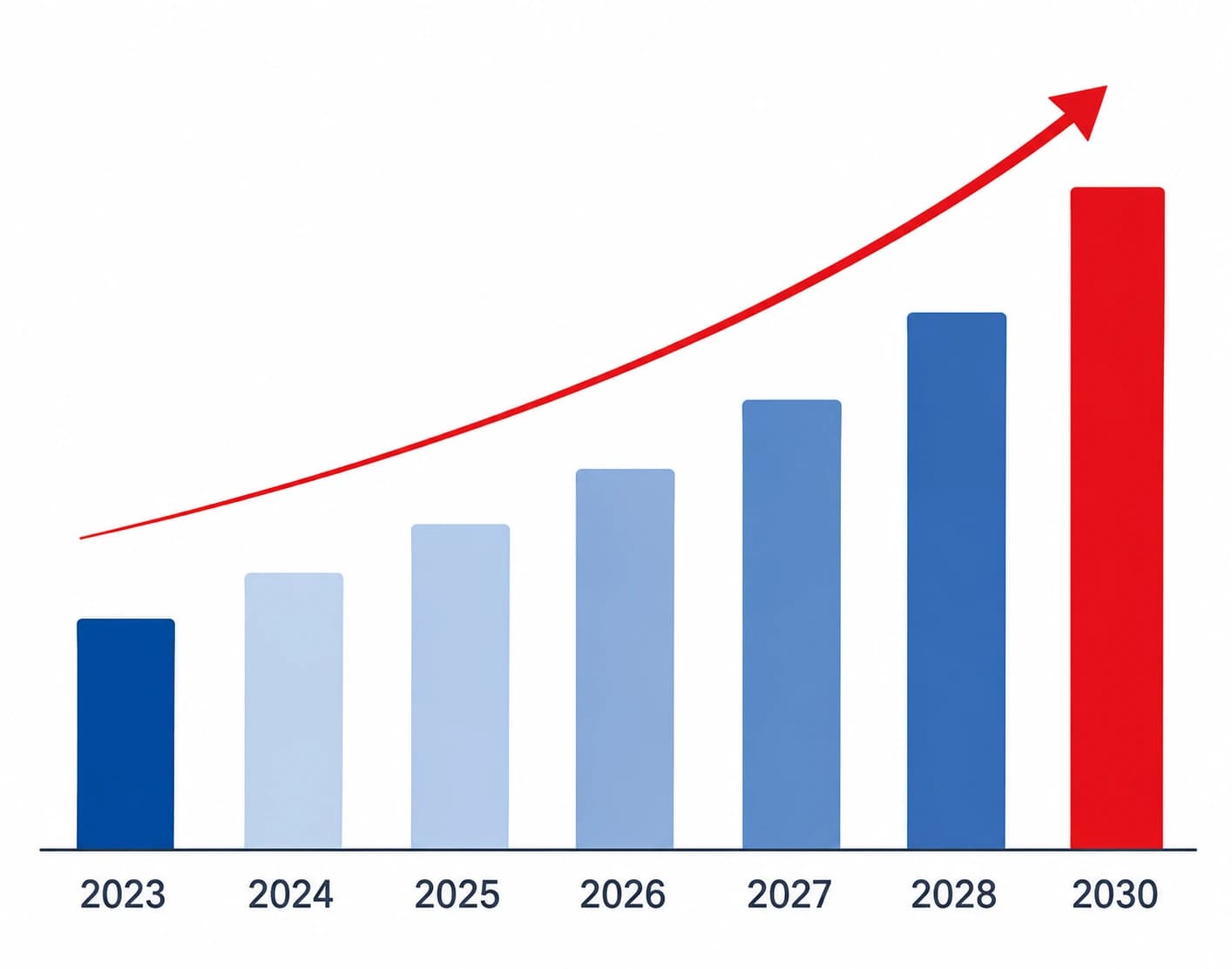
The global Electric Vehicle Battery Management System market was valued at US$ 6402 million in 2025 and is anticipated to reach US$ 20010 million by 2032, witnessing a CAGR of 17.9% during the forecast period 2026-2032.
Electric Vehicle Battery Management System is mainly for the intelligent management and maintenance of each battery unit, to prevent the battery from over-charging and over-discharging, to extend the service life of the battery and to monitor the state of the battery management system and the electric vehicle power battery together, through the sensor to the battery voltage, current, temperature, the real-time detection, as well as detect the leakage, thermal management, battery balanced management, alarm to remind, the residual capacity of computing (SOC), discharge power, report of the residual capacity of battery degradation (SOH) and the state of (SOC), according to the battery voltage and current and temperature also use algorithm of maximum output power control to achieve maximum range, as well as the best current algorithm control charger for charging, Through CAN bus interface, real-time communication is carried out with on-board general controller, motor controller, energy control system, on-board display system, etc.
In 2024, global electric vehicle battery management system production reached approximately 18,255 K units , with an average global market price of around US$ 280 per unit.
The electric vehicle battery management system (BMS) has evolved from a hidden electronic module into one of the most strategic technologies in the entire electrified powertrain stack. It sits at the centre of the high-voltage battery, continuously monitoring cell behaviour, coordinating charging and discharging, and acting as the “safety brain” that prevents abuse conditions. As hybrid, plug-in hybrid and battery electric vehicles scale up globally, the BMS is no longer judged only by whether it keeps the pack safe, but by how much real-world range, fast-charging robustness, lifetime and warranty cost it can unlock for OEMs. In practice, this means turning complex electrochemistry and highly variable usage profiles into stable, predictable performance that drivers can trust in all climates and use cases.
From a technology perspective, BMS architectures are moving from relatively simple, pack-level controllers toward more sophisticated, networked systems. Cell-monitoring ICs, distributed sensing and high-precision algorithms now work together to estimate State of Charge and State of Health more accurately over time, while active or passive balancing strategies help to reduce cell drift and extend pack life. At the same time, higher voltage platforms, faster DC charging, new chemistries such as high-nickel NMC and LFP, and structural pack designs all put additional pressure on BMS design. This has led to increased integration with thermal management, power electronics and charging systems, and to the emergence of centralised “battery domain controllers” that coordinate multiple packs or modules via high-speed communication. Cybersecurity, functional safety and over-the-air update capabilities are also becoming standard expectations as software content grows.
Industry dynamics around BMS reflect the broader electrification value chain. Traditional Tier-1 suppliers, battery cell manufacturers and semiconductor companies all compete and collaborate to offer hardware platforms, software stacks and reference designs that can be adapted across different vehicle segments. OEMs, especially those with strong in-house EV strategies, are weighing the benefits of vertical integration—developing their own BMS hardware and algorithms to differentiate range and fast-charge behaviour—against the cost and complexity of maintaining such capabilities. In parallel, the rise of battery swapping, second-life energy storage and increasingly stringent safety regulations is expanding the role of BMS beyond the vehicle itself, creating opportunities for common platforms that span automotive and stationary applications.
Looking ahead, the BMS market will be shaped by several long-term trends: the push toward higher energy density and faster charging, the need to guarantee performance over long warranties, the shift to domain/zonal electrical architectures and the growing importance of software-defined vehicles. These trends open significant room for innovation in sensing, algorithms, integrated circuits and system architecture, but also raise the bar on validation, safety and cost optimisation. Suppliers that can combine deep understanding of battery chemistry, robust automotive-grade electronics, secure and updateable software and strong application engineering support will sit in a favourable position as electrified vehicles move from early adoption to true mass-market penetration.
This report aims to provide a comprehensive presentation of the global market for Electric Vehicle Battery Management System, with both quantitative and qualitative analysis, to help readers develop business/growth strategies, assess the market competitive situation, analyze their position in the current marketplace, and make informed business decisions regarding Electric Vehicle Battery Management System.
The Electric Vehicle Battery Management System market size, estimations, and forecasts are provided in terms of sales quantity (K Units) and revenue ($ millions), considering 2025 as the base year, with history and forecast data for the period from 2021 to 2032. This report segments the global Electric Vehicle Battery Management System market comprehensively. Regional market sizes, concerning products by Type, by Application, and by players, are also provided.
For a more in-depth understanding of the market, the report provides profiles of the competitive landscape, key competitors, and their respective market ranks. The report also discusses technological trends and new product developments.
The report will help the Electric Vehicle Battery Management System manufacturers, new entrants, and industry chain related companies in this market with information on the revenues, sales, and average price for the overall market and the sub-segments across the different segments, by company, by Type, by Application, and by regions.
Chapter 1: Introduces the report scope of the report, executive summary of different market segments (by region, product type, application, etc), including the market size of each market segment, future development potential, and so on. It offers a high-level view of the current state of the market and its likely evolution in the short to mid-term, and long term.
Chapter 2: key insights, key emerging trends, etc.
Chapter 3: Manufacturers competitive analysis, detailed analysis of Electric Vehicle Battery Management System manufacturers competitive landscape, price, sales and revenue market share, latest development plan, merger, and acquisition information, etc.
Chapter 4: Provides profiles of key players, introducing the basic situation of the main companies in the market in detail, including product sales, revenue, price, gross margin, product introduction, recent development, etc.
Chapter 5 & 6: Sales, revenue of Electric Vehicle Battery Management System in regional level and country level. It provides a quantitative analysis of the market size and development potential of each region and its main countries and introduces the market development, future development prospects, market space, and market size of each country in the world.
Chapter 7: Provides the analysis of various market segments by Type, covering the market size and development potential of each market segment, to help readers find the blue ocean market in different market segments.
Chapter 8: Provides the analysis of various market segments by Application, covering the market size and development potential of each market segment, to help readers find the blue ocean market in different downstream markets.
Chapter 9: Analysis of industrial chain, including the upstream and downstream of the industry.
Chapter 10: The main points and conclusions of the report.
- ★ What Is The Overall Market Size And Projected Growth Rate Across Global And Regional Segments?
- ★ How Does The Market Size And Growth Outlook Vary Across Major Countries?
- ★ Which Region Or Market Sub-Segment Is Anticipated To Dominate Growth During The Forecast Period?
- ★ What Are The Primary Factors Expected To Drive Market Expansion, And What Challenges May Restrain Growth?
- ★ Which Emerging Technologies And Market Trends Are Shaping The Future Landscape?
- ★ What Are The Most Significant Opportunities Available In The Market?
- ★ Who Are The Leading Manufacturers Actively Participating In The Global Market?
- ★ Which Company Currently Holds The Largest Share Of The Market?
- ★ What Are The Potential Growth Avenues For New Entrants In The Global Market?